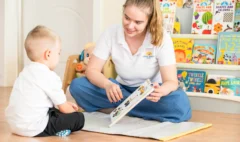
Sometimes the hardest part of being a parent, is not jumping in to help straight away. You reach over to zip the jacket, pour the water or fit the shoe, and a small, determined voice stops you: “I do it myself!” When you are already late for the door, it is easy to see this as a delay. Those instincts matter, it is your child learning that they are capable, and a Montessori classroom is set up to encourage independence rather than rush past it.
“Help me to do it myself”
More than a century ago, Dr. Maria Montessori noticed that young children have a strong drive to do things for themselves. Her guiding idea grew from it: never do for a child what they can learn to do on their own. Independence is not handed to a child when they are older. They build it gradually, from very early on, each time an adult steps back far enough to let them try.
A room built to a child’s scale
Walk into a Montessori early years room and the first thing you notice is that everything is within reach. Shelves are low, tools are real rather than toy versions and sized for small hands. Bags hang where a two-year-old can reach them, and a step by the sink means a child can wash their own cup. Montessori calls this the prepared environment. When a room is arranged this way, a child does not have to wait for an adult, they can simply begin.
Why practical life matters
Some of the most valued work in a Montessori classroom looks, at first, like ordinary housework. Children pour water, spoon, button, sweep, polish and prepare a snack. Montessori call these practical life activities, and they are where independence takes hold. Carrying a tray of cups across the room without spilling takes focus and care. Fastening a row of buttons is real problem solving. Each task a child masters becomes quiet proof to themselves that they can manage, and that belief carries into whatever they try next.
Freedom within limits
Independence needs room to grow. In a Montessori setting, children choose their own work from what is on offer, and they are given long, uninterrupted stretches of time, known as the work cycle, to stay with something until they have mastered it. A parent/educator watches closely but holds back from stepping in too quickly, because helping a child too soon tells them they could not have managed alone. The freedom is real, yet it sits inside clear and consistent limits. That balance is what helps children become capable and considerate at the same time.
What independence really builds
The buttoning and the pouring are only the surface, underneath a child is building something far more lasting. They learn to concentrate, to stay patient and to keep going when a task is hard. They begin to sense that their effort counts and that they can shape their own small world. The confidence that follows does not come from being praised, it comes from having genuinely done “the thing”. These are the foundations of a capable, self-assured learner, and they are laid long before a child picks up a pencil.
Supporting it at home
You do not need a classroom to encourage this. A few small changes make a real difference:
- Allow a little extra time. Build in the minutes your child needs to put on their own shoes, even when it is slower than doing it for them.
- Make things reachable. A low hook, a step at the sink or a snack shelf they can get to on their own turns “I can’t” into “I can.”
- Hold back on the quick rescue, pause before you step in. Given a moment, a child will often work it out.
- Bring them into real life. Let them wash the vegetables, carry a plate or water a plant. Children love doing the real thing alongside you.
For more ideas, see our guide to Screen free Montessori activities at home.
Why Great Minds ECC
At Great Minds, “I did it myself” is one of our favourite things to hear. It is the sound of a child finding out what they are capable of. Everything in our Montessori spaces is arranged to protect that discovery and give it room to grow.